The completion of a high-end renovation almost never coincides with the end of the building works. Those who manage residential sites know that the final perception of construction quality depends on the interaction between “hard” materials (tiles, wood, concrete) and “soft” ones. A common mistake is to consider the rug as a mere piece of furniture, forgetting that its function is purely architectural.
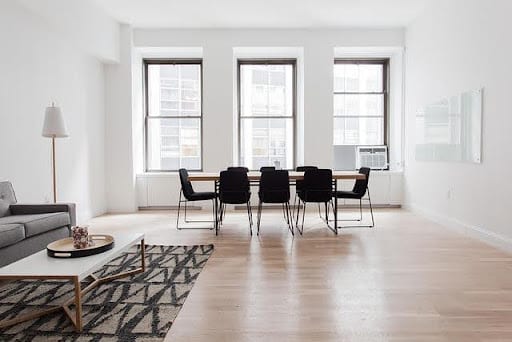
A room with high ceilings and large glass walls, typical of modern steel and glass structures, would be uninhabitable without an element capable of correcting sound reverberation and thermal dispersion. Designing a space also means predicting how surface materials will absorb light and noise. Integrating high-end textile solutions allows for a structural finish in rooms that would otherwise remain cold concrete spaces. The choice of material is not just about aesthetics, but the product’s ability to become an integral part of the domestic microclimate, improving the building’s overall performance.
Table of Contents
How to organize open spaces with rugs
Demolition works aimed at creating large living areas have removed the physical limits of walls but introduced the problem of spatial disorientation. In an open plan, the function of an area must be clear without the need for vertical barriers that block light.
The rug thus becomes the technical tool par excellence for horizontal space planning. To achieve a result worthy of a prestigious renovation, it is essential to focus on products that combine artistic vision and artisanal rigor. Using high-quality Nodus rugs allows for the definition of the perimeter of a living or dining area, creating an immediate visual hierarchy that anchors furniture to a solid and defined base. Nodus stands out on the international scene for transforming the rug from a simple accessory into a true numbered work of art, collaborating with the world’s most prestigious designers to guarantee pieces that are, in every respect, real investments.
In interior projects, it is common to make the mistake of using rugs that are too small or of low density, which fragment the space instead of unifying it. On the contrary, a large-format, high-quality piece, made according to the ancient knotting techniques that Nodus preserves in its certified laboratories, acts as a visual magnet, stabilizing the floor plan and providing a sense of order and proportion that increases the perceived value of the property. Choosing a brand with this design depth ensures that the textile heart of the home is not just a decorative object, but an iconic design element capable of resisting the passage of trends and time.
Indoor health and wellbeing: the advantages of natural fibers
The choice of materials is not just a matter of aesthetics, but of health. Many inexpensive industrial rugs are made with synthetic fibers and chemical glues that release Volatile Organic Compounds (VOCs) into the air for years. It is useless to use eco-friendly paints on the walls if we then introduce a rug that pollutes the air we breathe.
On the contrary, choosing a rug in pure Tibetan wool or silk is an excellent way to let the room “breathe.” Wool is an extraordinary material: it does not catch fire easily, naturally repels dirt thanks to lanolin, and helps regulate the room’s temperature. If the house has underfloor heating, a high-quality rug allows heat to rise uniformly without being damaged and, above all, without releasing chemical odors caused by heat.
In this way, the rug is no longer just a piece of furniture, but becomes a true ally for domestic wellbeing, just like a good window or a ventilation system. Finally, thanks to the dense weave of handmade knots, these rugs absorb the noise of footsteps, making the home much quieter and more livable, especially if there are neighbors downstairs or the house is on multiple levels.
Durability and investment value over time
A property renovated with luxury criteria must maintain its prestige for decades, not for seasons. In this sense, the durability of materials is the main parameter for evaluating the quality of the investment. Rugs produced with the hand-knotting technique represent the pinnacle of mechanical resistance. Each knot is a solid bond that protects the rug’s structure from mechanical wear and crushing.
While a mass-produced product shows signs of wear after just a few months, a designer rug ages gracefully, exactly like solid hardwood flooring or a natural stone surface. An attentive buyer evaluates the quality of details; finding pieces that blend millenary craftsmanship and contemporary design suggests a level of construction care above average, justifying a higher market price.
Final considerations for a high-end home
Ultimately, the success of an architectural project lies in the balance between the hardness of the construction and the softness of the surfaces. A house is not complete until every technical element dialogues with the tactile and visual experience of those who live there. Choosing excellence is not just an aesthetic act, but the final touch that certifies the quality of the entire building process. Investing in a high-end rug means adding value to the structure, ensuring the health of the environment, and making the home a place of timeless luxury where art meets daily functionality.