Foundation underpinning has evolved significantly over the past two decades. Where contractors once relied primarily on concrete spread footings and timber pilings, the modern repair industry now offers a range of engineered systems — each with specific advantages depending on soil conditions, structural loads, and project constraints.
For construction professionals working in regions with challenging geotechnical conditions — particularly areas with expansive clay soils like those found across Oklahoma, Texas, and the broader Southern Plains — understanding the differences between helical piers, steel push piers, and polyurethane foam injection is essential for recommending the right solution to clients.
Table of Contents
Understanding the Problem: Why Underpinning Is Needed
Foundation underpinning becomes necessary when the existing bearing soil can no longer support the structure’s load at its current depth. The most common causes include:
- Consolidation of fill soils placed without adequate compaction
- Shrink-swell cycles in expansive clay (montmorillonite-rich soils)
- Erosion or washout beneath footings due to poor drainage
- Organic decomposition in soils with high organic content
- Changes in groundwater levels affecting effective soil stress
Helical Piers: Precision Engineered for Variable Conditions
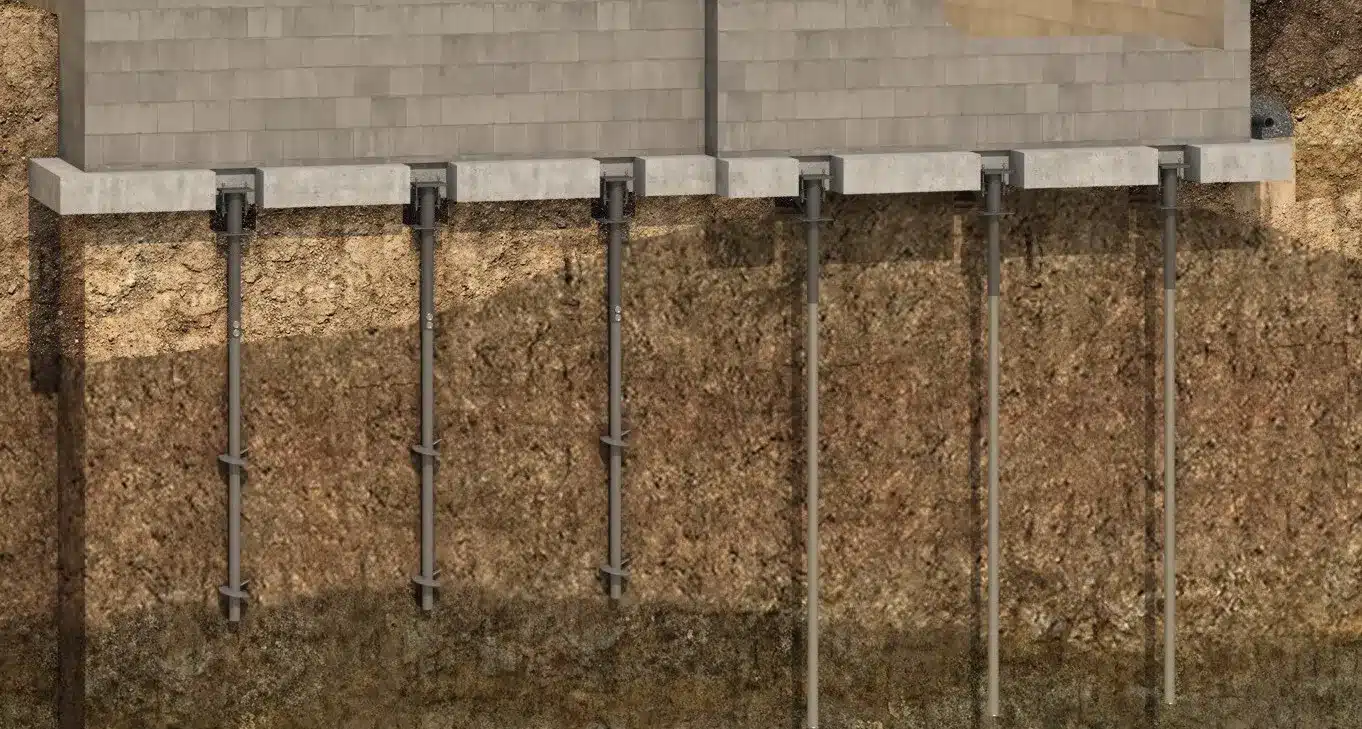
Helical piers consist of steel shafts with one or more helical plates welded at intervals along the lead section. They are advanced into the ground using hydraulic rotary equipment, and the installation torque is directly correlated to bearing capacity.
Technical Specifications:
- Shaft diameter: 1.5″ to 3.5″ residential; up to 10″ commercial
- Helix diameter: 8″ to 14″ standard; multi-helix configurations common
- Load capacity: 20,000 to 500,000+ lbs per pier
- Installation depth: 15–50 feet; deeper with extensions
Helical piers excel in new construction and lightweight structures. The real-time torque monitoring during helical pier installation provides immediate feedback on bearing capacity, allowing field adjustments to pier depth and configuration.
Steel Push Piers: Leveraging Structural Weight for Deep Bearing
Steel push piers consist of high-strength steel pipe sections hydraulically driven into the ground using the weight of the existing structure as a reaction force.
Technical Specifications:
- Pipe diameter: 2-7/8″ to 3-1/2″ OD residential
- Load capacity: 30,000 to 75,000+ lbs per pier
- Installation depth: 20–80 feet
- Driving force: Typically 1.5x estimated dead load
For projects requiring stabilization and lift, steel pier systems allow contractors to first drive to refusal, then reverse the hydraulics to apply controlled lift pressure across multiple piers simultaneously.
Polyurethane Foam Injection: Rapid Stabilization and Void Fill
Polyurethane foam injection involves injecting expanding two-component resin beneath slabs through small drilled ports.
Technical Specifications:
- Foam density: 2–6 lb/ft³
- Compressive strength: 40–100+ psi
- Expansion ratio: 15:1 to 25:1
- Cure time: Functional strength in 15–30 minutes
Foam injection is most effective for concrete leveling — driveways, garage floors, sidewalks, and warehouse slabs where settlement is moderate.
Choosing the Right Method: A Decision Framework
| Factor | Helical Piers | Push Piers | Foam Injection |
|---|---|---|---|
| Existing heavy structure | ✓ | ✓✓ | Limited |
| Lightweight structure | ✓✓ | ✗ | Limited |
| New construction | ✓✓ | ✗ | ✗ |
| Deep bearing required | ✓✓ | ✓✓ | ✗ |
| Slab leveling | ✗ | ✗ | ✓✓ |
| Void filling | ✗ | ✗ | ✓✓ |
| Rocky/cobble soil | ✗ | ✓ | N/A |
| Expansive clay (deep) | ✓✓ | ✓✓ | Limited |
In practice, many projects combine methods — push piers for perimeter stabilization alongside foam injection for a settled garage slab.
The Role of Geotechnical Investigation
Regardless of method, a thorough understanding of subsurface conditions is the foundation of every successful underpinning project. For larger commercial projects, formal geotechnical borings with lab testing of Atterberg limits, moisture content, and unconfined compressive strength provide the data needed to engineer the repair with confidence.
Written by the team at Level Home Foundation Repair — Tulsa’s trusted foundation specialists since 2003.