The conversation around energy-efficient building has shifted dramatically in recent years. Where solar panels and high-performance insulation once dominated the discussion, a growing number of architects and general contractors are now looking underground for answers. Geothermal heating and cooling — long considered a specialty upgrade — is becoming a practical consideration in new construction planning.
Table of Contents
The Construction Advantage: Building Geothermal From the Start
Retrofitting an existing building with a geothermal system is doable but expensive. Drilling boreholes, trenching loop fields, and rerouting ductwork in a completed structure adds cost and complexity that can double the installation timeline.
New construction flips the equation entirely. When geothermal is designed into a project from the foundation stage, contractors can:
- Coordinate loop field installation alongside excavation work already happening on site
- Size mechanical rooms properly for heat pump equipment
- Integrate hydronic distribution systems without tearing into finished walls
- Avoid the landscaping restoration costs that come with retrofit trenching
The result is a significantly lower cost premium. Industry estimates suggest incorporating geothermal during new construction adds 10 to 20 percent to HVAC costs, compared to 30 to 40 percent for retrofits. For a $500,000 commercial build, that difference can be $25,000 or more in savings.
Understanding the Ground Loop: What Builders Need to Know
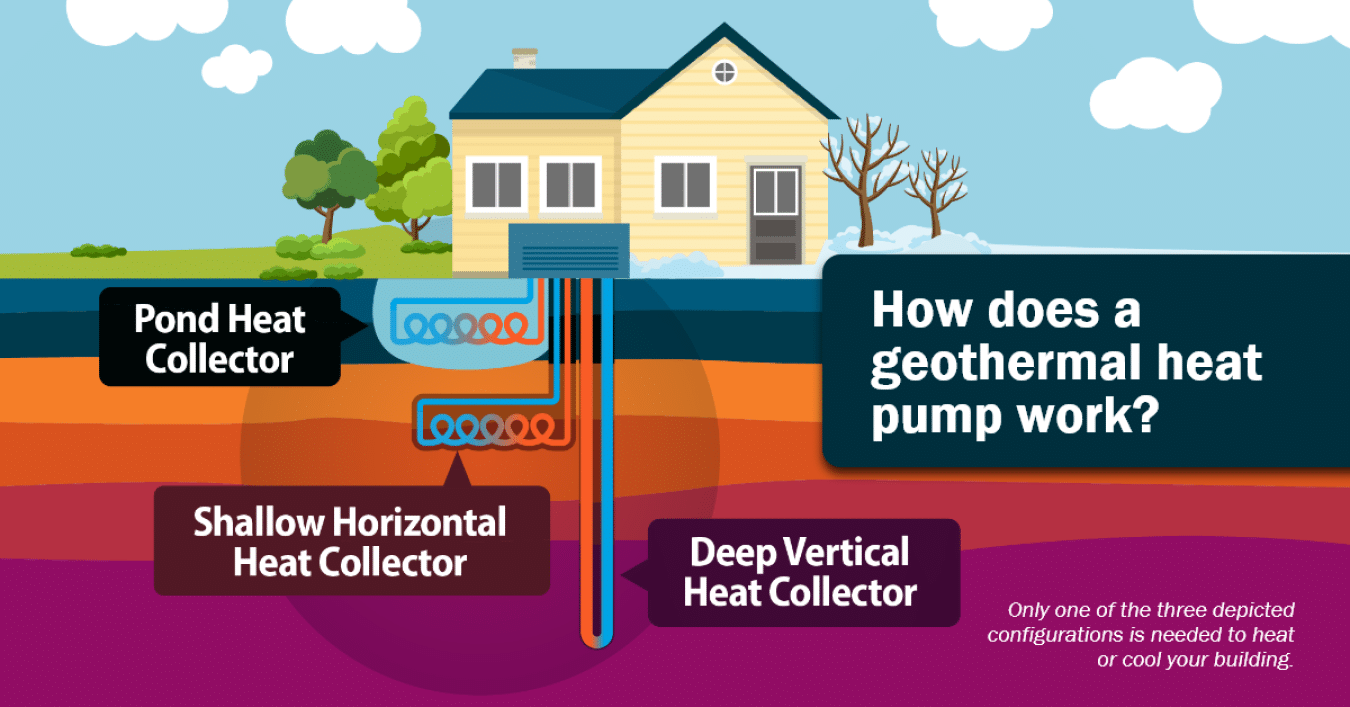
The ground loop is the heart of any geothermal system. It’s the network of high-density polyethylene pipes buried underground that circulates a water-antifreeze solution to exchange heat with the earth.
For builders, the key decisions involve loop configuration and site suitability:
Vertical closed-loop systems are the most common for commercial projects. Boreholes are drilled 150 to 400 feet deep and spaced 15 to 20 feet apart. This configuration works well on constrained sites where horizontal trenching isn’t feasible.
Horizontal closed-loop systems require more land but less drilling. Trenches run 4 to 6 feet deep and need roughly 1,500 to 1,800 square feet of ground per ton of heating and cooling capacity. A typical 5-ton residential system would need 7,500 to 9,000 square feet of available ground.
Hybrid systems combine a ground loop with a conventional cooling tower or boiler to handle peak loads. This approach reduces the required loop field size — and cost — by 20 to 30 percent while still capturing most of the efficiency gains.
Before committing to any configuration, a thermal conductivity test should be performed on the site. This 48-hour test measures how efficiently the local soil and rock transfer heat, and it directly determines loop sizing. Working with firms that specialize in geothermal energy consulting ensures the system is engineered for the specific geology of the project site rather than relying on generic regional assumptions.
The Numbers That Matter to Project Owners
Builders increasingly find that project owners and developers are asking about geothermal because the financial case has strengthened considerably:
- Operating costs drop 40 to 60 percent compared to conventional forced-air systems
- Equipment lifespan reaches 25 years for indoor components and 50+ years for ground loops
- Federal tax credits cover 30 percent of installation costs through 2032 under the Inflation Reduction Act
- Maintenance costs are minimal — no outdoor condenser units, no refrigerant charges, fewer moving parts
- Property value increases measurably — studies show geothermal-equipped homes sell for 3 to 5 percent more
For commercial projects pursuing LEED certification, geothermal systems contribute significantly to energy performance credits. Several categories including Optimize Energy Performance and Renewable Energy Production can be partially satisfied through a properly designed ground-source system.
Common Concerns From the Builder’s Perspective
Despite the advantages, some contractors hesitate around geothermal. The most frequent concerns are practical ones:
“Drilling adds time to the schedule.” Vertical boring typically takes 1 to 3 days per borehole. A 10-ton commercial system might need 6 to 8 boreholes, putting total drilling time at roughly 2 weeks. When scheduled alongside foundation work, the impact on the critical path is minimal.
“We don’t have the expertise in-house.” Most builders subcontract the geothermal work to specialized drilling and mechanical contractors. The builder’s role is coordinating the sequence — ensuring loop fields are installed before hardscaping and that mechanical rough-in accommodates heat pump specifications.
“What if the site conditions are wrong?” This is precisely why the thermal conductivity test exists. A $3,000 to $5,000 test investment prevents six-figure design mistakes. No reputable geothermal designer would size a system without one.
Looking Ahead: Building Codes and Market Direction
Several states have adopted or are considering building electrification requirements that will phase out fossil fuel heating in new construction. New York, Washington, and Colorado already have legislation moving in this direction. When natural gas is no longer an option, geothermal becomes one of the most efficient all-electric heating solutions available.
For builders who start developing geothermal expertise now, the competitive advantage is substantial. The contractors and developers who understand ground-source systems today will be the ones winning projects when electrification mandates take full effect tomorrow.