This guide is written for designers and builders working on residential and commercial projects across Southwest Florida, and for homeowners who want to understand the material decisions that actually matter before they commit to a renovation. It covers kitchen and bathroom tile specifically: which materials hold up in the local climate, where each one performs best, and the selection decisions that tend to produce problems when they are made without accounting for regional conditions.
Table of Contents
Why Florida changes the tile conversation in kitchens and bathrooms
Kitchens and bathrooms are already the most demanding rooms in any home from a tile-performance standpoint. They combine moisture, thermal cycling, cleaning chemicals, food and cosmetic staining, and foot traffic in a concentrated space. In Southwest Florida, all of those demands happen inside a climate that maintains average relative humidity between 74% and 80% year-round, with coastal areas frequently higher.
That baseline humidity affects grout, sealers, certain glazes, and the performance of any tile system that was not specified with moisture as the primary variable. It also affects how a finished surface looks and feels over time. Grout that holds up well in drier climates can stain, crack, or support organic growth in Gulf Coast bathrooms within a year or two of installation. Natural stone that is low-maintenance in an air-conditioned Chicago apartment requires considerably more attention in a home where the sliding doors to the lanai are open for most of the day.
For designers and builders, specifying tile in this market means accounting for conditions that national product guides frequently understate. For homeowners, it means that the guidance of someone who understands the local environment is worth considerably more than a product page.
Kitchen tile
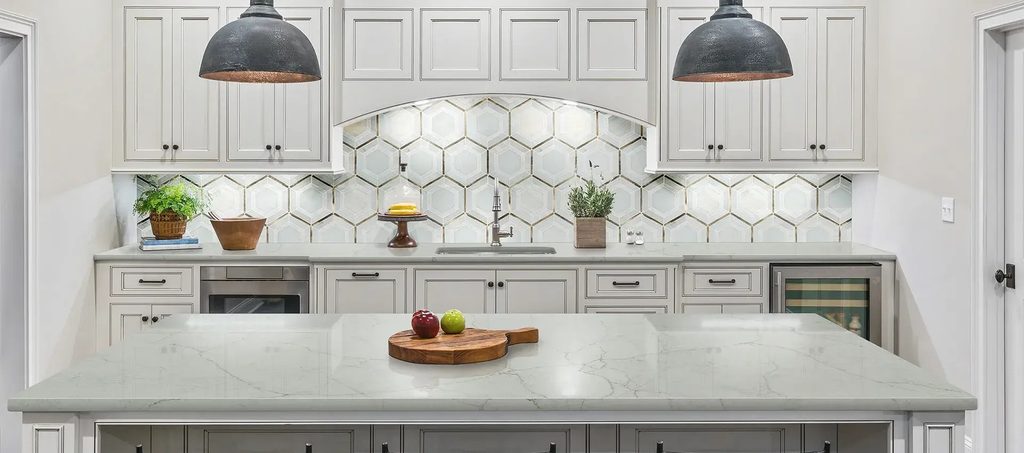
The kitchen is where tile decisions carry the most visual weight and the most practical consequence simultaneously. Backsplash tile, floor tile, and countertop-adjacent surfaces all need to handle daily cooking activity, cleaning, and the kind of long-term scrutiny that comes from being one of the most-used rooms in a home.
Large-format porcelain for kitchen floors
Porcelain tile is the most consistently appropriate kitchen floor material for Gulf Coast homes, and it has reached a point aesthetically where it competes directly with natural stone and hardwood without the maintenance demands those materials carry in Florida’s conditions.
Non-porous by manufacturing, porcelain does not absorb moisture, is unaffected by the humidity fluctuations that cause wood to expand and contract, and does not require sealing to maintain its performance. Large-format porcelain in stone-look and concrete-look finishes is the current standard for high-end kitchen renovations across Sarasota and Naples. The minimal grout lines of a 24×48 or 32×32 format create the clean, continuous visual planes that suit open-plan Gulf Coast kitchens and make daily cleaning considerably more straightforward than smaller format tiles with wider grout joints.
For commercial kitchen applications, including restaurants and hospitality properties, slip resistance is a specification requirement, not a preference. The coefficient of friction rating for the specific tile in wet conditions needs to be confirmed against the application before the selection is finalized.
Kitchen backsplash tile
The backsplash is where the material conversation shifts. Because it is a vertical surface above the countertop rather than a floor that takes direct foot traffic, the performance constraints narrow and the design range opens up considerably.
This is where glass tile, ceramic, handmade-look surfaces, and decorative formats that would not survive on a kitchen floor become entirely appropriate. A handcrafted ceramic backsplash in a matte, slightly irregular glaze introduces texture and warmth in a way that porcelain rarely does at the same price point. Glass tile in a backsplash application catches light differently throughout the day, which in a south or west-facing kitchen along the Gulf Coast creates an effect that changes noticeably between morning and afternoon.
Quartz slab backsplashes, running a single material continuously from the countertop to the upper cabinetry, are increasingly common in high-end Sarasota and Naples kitchen renovations. They eliminate grout lines entirely, which makes them exceptionally easy to clean and gives the kitchen a resolved, architectural quality. The same material used on the countertop and carried up the wall as a slab backsplash is one of the most effective ways to create a cohesive kitchen without needing to coordinate multiple materials.
For homeowners, the backsplash is also the lowest-risk place to introduce a tile with more visual character. Because it covers a relatively small surface area, a tile with strong pattern, color, or texture reads as a considered design decision rather than an overwhelming one.
Grout in Florida kitchens
The grout specification matters as much as the tile specification in a Gulf Coast kitchen, and it is the decision that gets shortchanged most often.
Standard cement-based grout in a kitchen backsplash will stain from cooking oils and absorb color from food and cleaning products over time, regardless of how well it is sealed initially. Epoxy grout is non-porous, does not require sealing, resists staining and bacterial growth, and performs consistently in the kind of sustained moisture and heat environment that a working kitchen creates. The additional upfront cost is consistently less than the remediation cost when standard grout fails prematurely, which in Gulf Coast conditions it tends to do.
Bathroom tile
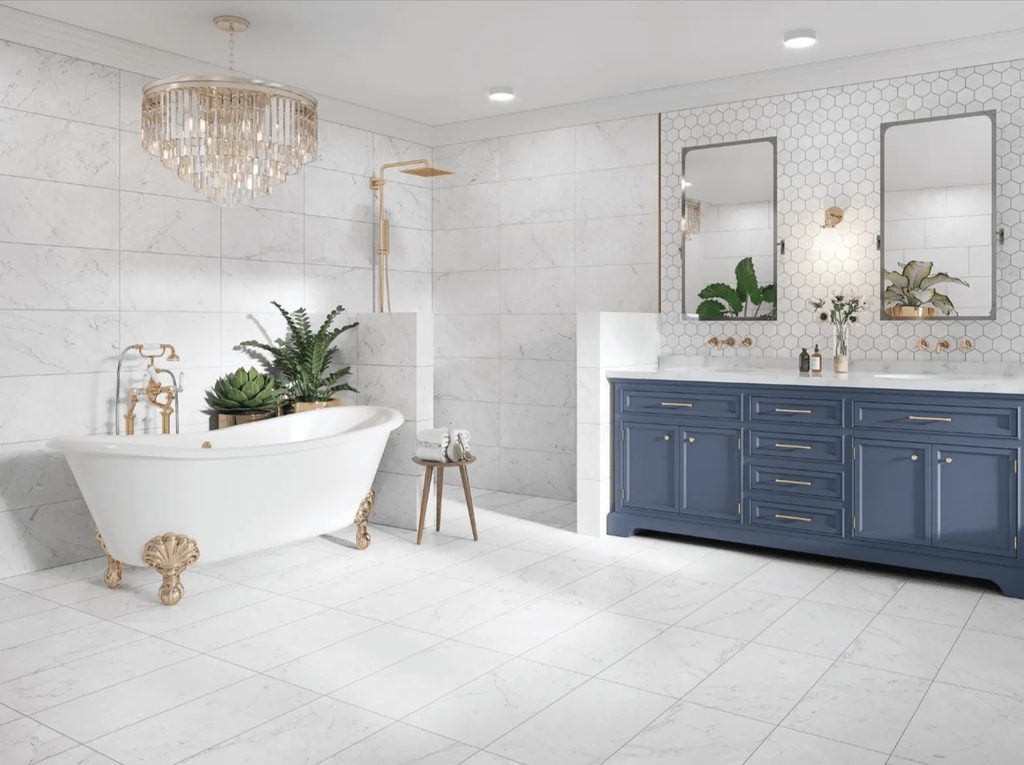
Bathrooms in Southwest Florida are wet environments inside an already humid climate. Shower walls, wet-area floors, and surfaces adjacent to open windows or exterior access points are all working harder than their equivalents in drier regions, and the material decisions that govern how they perform over a decade are made at the specification stage.
Shower walls and wet areas
Porcelain and ceramic tile remain the most practical specification for shower walls and wet areas in Florida bathrooms. Both are non-porous, resistant to the sustained moisture that shower environments create, and available in the full range of formats, from large-format slabs that minimize grout lines to smaller mosaic tiles that add texture and slip resistance to shower floors.
The decision between large-format and smaller format in a shower wall is primarily visual and practical. Large-format porcelain slabs in a shower create a clean, spa-like quality with very few grout lines, which suits the contemporary design language of current high-end Gulf Coast projects and reduces cleaning maintenance over time. Subway tile in a handmade or textured format introduces a different quality, one with more craft character and warmth, that works particularly well in transitional or more traditional interiors.
Natural stone in shower applications is a specification that requires a clear conversation with the client. Marble, travertine, and limestone showers can be genuinely beautiful, and the warmth and variation of natural stone is something that manufactured materials do not fully replicate. They also require sealing on a schedule appropriate to the exposure level, they are susceptible to etching from acidic products and body care items, and in a Florida coastal environment the maintenance conversation is more consequential than it would be in a drier climate. For clients who understand and accept that responsibility, natural stone showers are an appropriate and rewarding specification. For clients who want a low-maintenance bathroom, porcelain in a stone-look finish achieves a very similar aesthetic without the upkeep.
Bathroom floors and the slip resistance conversation
The bathroom floor is where the slip resistance conversation becomes non-negotiable. A floor that is beautiful and completely safe when dry can be genuinely hazardous when wet, and in a primary bathroom used daily, the wet floor condition is not an edge case.
Smaller format tiles with more grout joints provide more friction through the grout lines themselves and are a practical choice for shower floors specifically. Mosaic tile, whether porcelain, glass, or natural stone, is the traditional specification for shower floors for exactly this reason. For the main bathroom floor outside the shower, a lightly textured or structured porcelain surface in a larger format balances the safety requirement with the cleaner visual quality of fewer grout lines.
Polished marble and polished limestone on bathroom floors in Gulf Coast homes present a consistent challenge: polished stone is beautiful, it shows water immediately, and it can be slippery when wet. A honed finish on the same material resolves the safety concern and creates a softer, more matte surface quality that reads well in natural light. For designers specifying natural stone bathroom floors, honed or brushed finishes are almost always the more practical choice in Florida.
Feature walls and decorative tile in bathrooms
The bathroom offers more opportunity for expressive tile work than almost any other room in a home, precisely because the surfaces are contained and the scale is manageable. A single feature wall behind the freestanding tub, a niche tiled in a material or pattern that differs from the surrounding shower walls, or a mosaic floor in the shower that contrasts with a quieter wall tile — these decisions create the moments that make a bathroom feel genuinely designed rather than simply completed.
In the current Southwest Florida market, the most consistently well-executed approach is restraint with a single point of emphasis. One material or surface that is given room to be noticed, surrounded by quieter choices that support it. A bold handmade ceramic accent tile loses most of its impact when it is competing with an equally strong floor pattern, a dramatic stone vanity top, and heavily veined wall tile simultaneously.
Where to source kitchen and bathroom tile for Southwest Florida projects
Florida Design Works maintains showrooms in Sarasota, Fort Myers, and Naples serving trade professionals and homeowners across the Suncoast region. With 58 years of experience in the Florida market, the team understands what the local climate actually asks of interior materials, and that experience informs the advice on product performance, grout selection, and application-specific decisions that national resources frequently get wrong or gloss over.
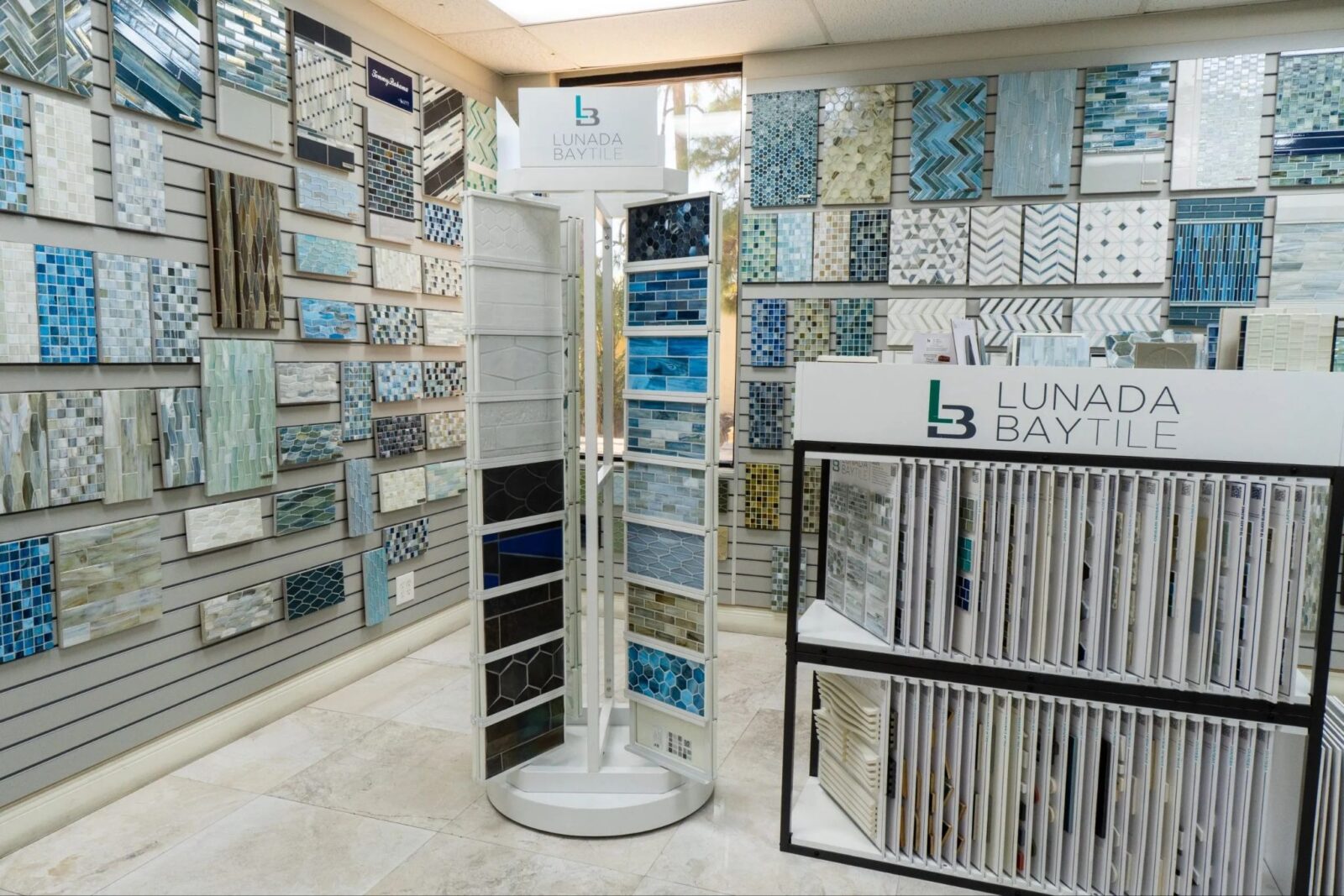
The tile offering across locations includes brands such as Atlas Concorde, Sonoma Tilemakers, Walker Zanger, AKDO, Lunada Bay, Mir Mosaics, Florida Tile, Emil Ceramica, and Tuscania, covering the full range from porcelain, ceramic, and glass through natural stone and decorative mosaics at different price points and design directions.
For designers and builders, the team is set up to support the full project from specification through logistics, including lead time and availability conversations that need to happen before a selection is committed to a drawing set. For homeowners, the showroom is a place to see materials together in person, under real light, in combinations that reflect how they will actually behave in a finished room rather than as individual samples on a white background.
Tile decisions made in a showroom, with actual samples in hand and someone who understands the local environment available to answer the questions that matter, tend to be better decisions than the ones made from a product page. That is true in any market. In Southwest Florida, where the conditions are genuinely specific and the consequences of a poor specification live in a home for decades, it is especially true.
Frequently asked questions about selecting tile in Southwest Florida
Is natural stone a bad choice for a Florida shower?
Not at all, but it requires a realistic commitment to maintenance. Marble, travertine, and limestone bring organic warmth and unique variation to a bathroom that manufactured materials cannot completely replicate. However, because natural stone is porous, it requires routine sealing and must be cleaned with non-acidic, stone-safe products. In Florida’s humid environment, neglecting that care leads to water staining, etching, and moisture issues. If you want a zero-fuss shower, a high-end stone-look porcelain is usually the smarter alternative.
Why does grout selection matter so much in Gulf Coast homes?
Standard cement-based grout is naturally porous. In Southwest Florida, where average relative humidity stays between 74% and 80%, traditional grout easily absorbs water, cooking oils, and cosmetic chemicals, quickly becoming a breeding ground for mold and mildew. Specifying non-porous epoxy grout on kitchen backsplashes and in wet areas prevents staining, eliminates the need for periodic sealing, and lasts significantly longer under heavy humidity.
Are large-format porcelain tiles practical for kitchen floors?
They are actually the ideal choice. Large-format porcelain tiles, such as 24×48 or 32×32 inch slabs, are completely non-porous and will not expand or contract with Florida’s humidity changes. Beyond their durability, large tiles drastically reduce the number of grout lines on your floor, creating a clean, continuous visual plane that makes daily sweeping and mopping much easier.
How do I prevent bathroom floor tiles from becoming too slippery when wet?
Focus on format and finish. For shower floors, smaller mosaic tiles are standard because the high density of grout lines creates natural foot traction. For the main bathroom floor outside the shower, opt for a lightly textured or structured porcelain tile, or choose a honed or brushed finish if you are installing natural stone. Highly polished marble or glazed tiles on a main bathroom floor can create a serious slip hazard when stepped on with wet feet.
Can I use glass tile on a kitchen floor?
No. Glass tile is designed for vertical or low-impact surfaces like kitchen backsplashes, shower walls, or decorative accents. It cannot withstand direct foot traffic or structural weight without cracking. However, installed as a backsplash, glass tile performs brilliantly. It is completely non-porous, wipes down effortlessly, and catches natural coastal light in ways that add incredible depth to the room.
What is the benefit of a full-slab quartz backsplash over traditional tile?
A quartz slab backsplash carries a continuous sheet of quartz directly from the countertop up to the cabinetry. This eliminates grout joints entirely, removing the primary area where grease and cooking oils accumulate. It gives the kitchen a seamless, architectural look while making cleanup as simple as wiping down a single flat surface.
Why should I consult a local tile specialist instead of ordering online?
National product listings and online specs rarely account for Florida’s specific environmental conditions. Regional specialists understand how local humidity, intense sun exposure, and coastal salt air affect tile glazes, setting materials, and sealers over time. Seeing physical samples under natural lighting and getting localized advice on grout and slip ratings ensures you choose materials built to last in the Suncoast climate.