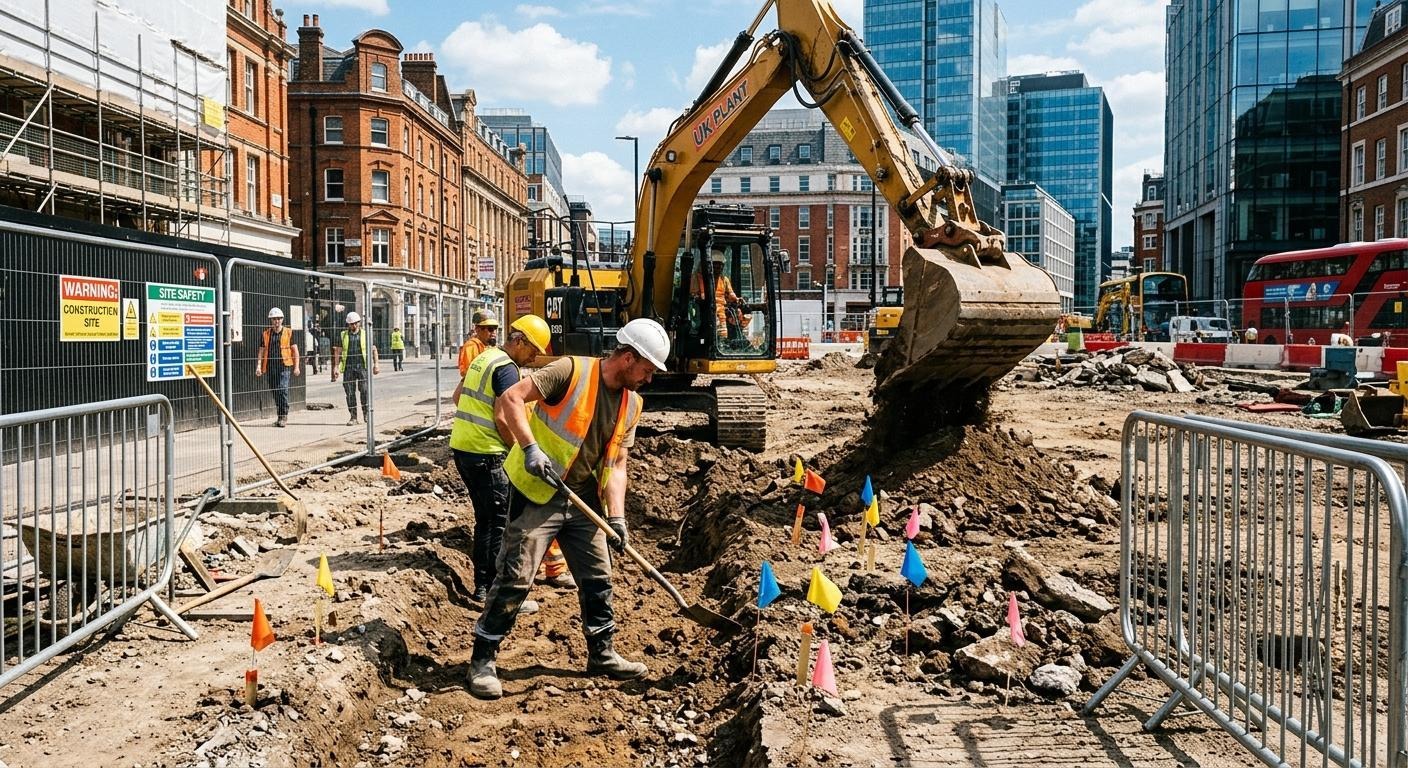
A construction crew excavates near utility marker flags on an active urban job site
More than 550 underground utility damage incidents happen every single day across the United States. That’s not a dramatic statistic cooked up for a safety training video – it comes straight from the Common Ground Alliance, the industry body that tracks these events. Most of the time, the crew that hit the line had called 811. They had followed the minimum steps. And they still struck something.
For contractors, hitting a buried line isn’t just a safety emergency. It’s a liability event that can stop a project cold, trigger regulatory fines, and in the worst cases, put workers in the hospital. The reason so many strikes happen isn’t ignorance – it’s a widespread assumption that calling 811 is enough. It isn’t.
This guide covers what contractors need to know about utility locating before any excavation begins: where 811 falls short, when to bring in a professional locator, how Texas-specific rules apply, and what a solid pre-dig checklist actually looks like.
Table of Contents
When 811 isn’t enough
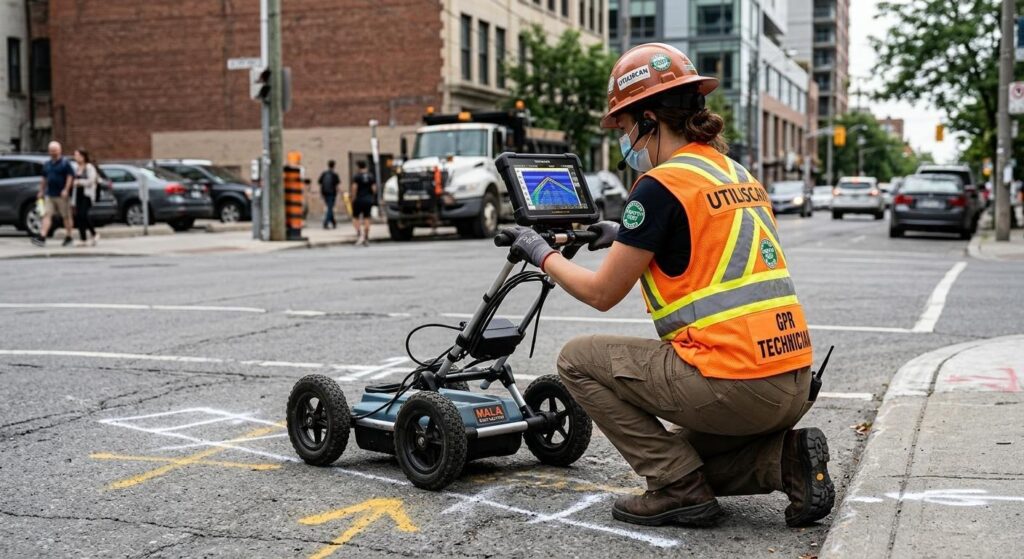
A technician uses GPR equipment to map buried utilities that 811 markings won’t identify
Most contractors know 811 as the “call before you dig” number. What few understand is the gap between what 811 marks and what’s actually buried on a given site.
The 811 system notifies member utility companies – gas, electric, telecom, water – and they dispatch locators to mark their lines from the street to the meter. That’s it. Everything on the property side of the meter is outside 811’s scope: private irrigation systems, secondary electrical feeds, in-ground fiber runs, and repurposed utility lines from previous structures. On any developed commercial site or older residential property, there’s a good chance several of these exist, and none of them will show a flag.
This is where professional locating becomes the practical choice rather than an optional upgrade. For construction projects in South Texas, contractors frequently rely on utility location services in San Antonio to identify exactly the kind of lines that 811 won’t flag – private utilities, unrecorded infrastructure, and lines that have shifted from where any map shows them. The technology these services use differs from that carried by 811 locators: electromagnetic (EM) detection finds conductive lines, and ground-penetrating radar (GPR) maps non-metallic pipes, voids, and anything not showing up in utility records.
Professional locating isn’t a replacement for 811. It’s the second layer that catches what 811 can’t. On large commercial sites, urban cores with decades of buried infrastructure, or any job where records are incomplete, skipping that second layer is the most common reason strikes happen on sites where the contractor believed they’d done everything right.
Why utility strikes keep happening despite the rules
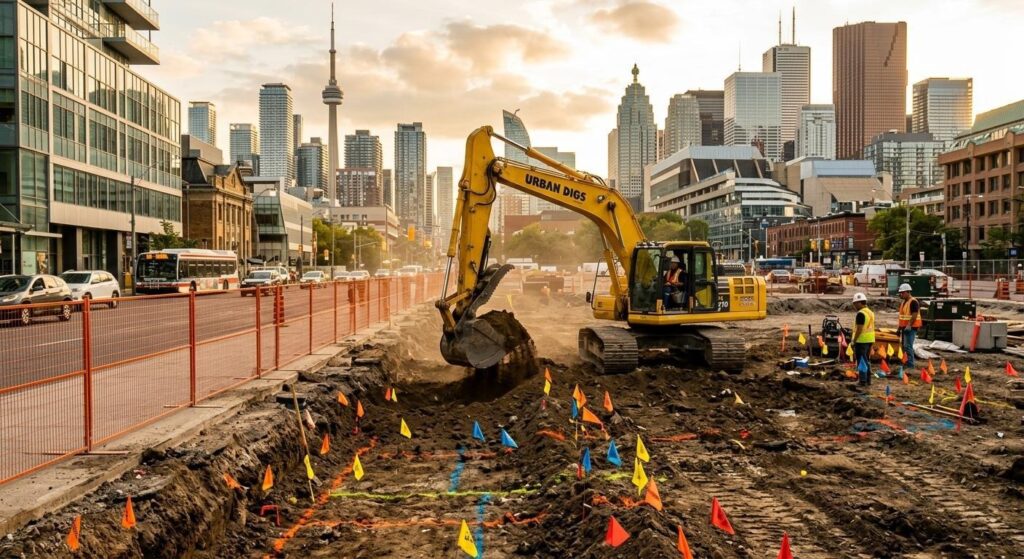
Utility marking flags indicate buried lines – but flags only mark what 811 member utilities choose to report
According to the Common Ground Alliance’s 2024 DIRT Report, there were 196,977 unique damage incidents recorded that year. The CGA Index – a measure of overall industry performance on damage prevention – rose from 94.0 in 2023 to 96.7 in 2024, which sounds like progress until you know the Index is designed so that higher numbers mean the industry is doing worse, not better.
The cost picture is equally sharp. Underground strikes cost the U.S. industry an estimated $30 billion annually. The average direct cost per strike runs around $4,000, but that figure is misleading because indirect costs – project delays, equipment downtime, liability claims, regulatory penalties – multiply the total by roughly 29 times. A $4,000 repair can easily become a $116,000 event once the full bill comes in.
The pattern behind most of these incidents is consistent. Backhoes and excavators account for nearly 50% of all damage, and contractors carry liability in more than 75% of strike cases. The CGA estimates 76% of all strikes were preventable. That’s not a margin for debate – it’s a description of choices made before excavation started.
One factor that rarely gets flagged is the assumption about the subcontractor. A general contractor’s 811 ticket does not cover subcontractors working on the same site. Each sub who’s going to break ground needs to pull their own ticket. This rule catches many experienced crews off guard.
For any contractor thinking through broader construction site safety practices, utility strikes rank among the most costly and disruptive events a project can face – because, unlike a fall or an equipment accident, a gas line rupture can affect everyone on the site at once.
The 811 process and what it actually covers
Calling 811 starts a formal notification process. The system routes the request to member utility companies, which then dispatch locators to mark their lines with flags and paint before excavation begins. In Texas, the law requires anyone planning to dig deeper than 16 inches to notify Texas 811 at least 48 hours and no more than 14 days before excavation starts.
That 48-hour minimum isn’t a suggestion. It’s the legal minimum under Texas law, and it means that project scheduling must account for the wait time. Submitting your ticket the morning of the dig isn’t an option.
OSHA 29 CFR 1926.651 adds a federal layer on top of state requirements. It requires employers to determine the estimated location of all underground utilities before opening any excavation, and to use detection equipment if utility companies can’t respond in time. This means “we called and never heard back” isn’t a legal defense if something goes wrong.
Two things contractors often overlook: first, 811 only marks public utilities – it won’t touch anything private. Second, markings show the approximate location of a utility, not its exact depth. Soil erosion, past excavations, and improperly installed lines can put pipes and cables shallower than any map or flag suggests.
The tolerance zone rule and how to dig safely near marked lines
Texas, like most states, defines a tolerance zone around every marked utility: 18 inches on either side of the outer edge of any marked line. Within that zone, mechanical excavation is off the table. Hand tools, hydrovac, or vacuum excavation only.
Potholing is the practical method most experienced crews use. A pothole is a small test excavation – hand-dug or vacuum excavated – that physically confirms the depth and exact position of a line before any heavy equipment gets close. It takes time. It’s worth it every time.
Before any of this happens, knowing the APWA color code system is non-negotiable. Red marks electric power lines. Yellow is a gas or other flammable material. Orange covers communications and fiber. Blue is water. Green is sewer. White paint or flags mark the proposed area of excavation – put these down before calling 811 so locators know exactly where to mark.
The depth assumption problem deserves a direct warning: never assume a line is at the depth shown on utility records. The CGA’s 2024 DIRT Report documents thousands of incidents where lines were found shallower than marked due to erosion, freeze-thaw cycles, or previous construction that moved soil. Potholing near any marked line before deploying a bucket is cheap insurance.
Understanding how this fits into the full sequence of groundwork and site preparation helps contractors see utility locating not as a separate task but as the first step in a connected pre-excavation workflow.
A pre-excavation utility locate checklist
The difference between a project that runs on schedule and one that gets stopped by a strike usually comes down to whether this sequence was followed before the first bucket drop.
White-line the planned dig area before calling 811. Locators need to know where you intend to excavate – white flags or paint marks the proposed area, so they mark their lines in the right place.
Submit your 811 ticket at least 48-72 hours before excavation. In Texas, the legal minimum is 48 hours, and the maximum is 14 days out. Don’t push either boundary.
Verify that every subcontractor who will be digging has their own 811 ticket. The GC’s ticket doesn’t transfer. Each sub needs to pull their own independently.
Wait for all utility confirmations before any excavation begins. If a utility company hasn’t responded, don’t assume the area is clear – follow up, or use detection equipment as OSHA 1926.651 requires.
Hire a private locator for any site with private utilities, incomplete records, or infrastructure that predates reliable mapping. This is particularly relevant on sites that were previously developed or that have irrigation, private fiber, or secondary electrical infrastructure.
Pothole near every marked line before bringing in heavy equipment. Confirm the actual depth and position before a bucket enters the tolerance zone.
Hand-dig only within the 18-inch tolerance zone. No exceptions based on schedule pressure.
Brief the crew on APWA color codes before each project starts. Not just the operator – everyone on site should know what a yellow flag means before the first shovel goes in.
These aren’t bureaucratic hoops. For any project involving trenching or foundation work, proper pipe trench installation starts with knowing what’s already in the ground. Skipping the locate steps to save a day is how a three-week delay happens instead.
Wrapping up
Utility locating doesn’t protect you from every risk on a job site, but it directly addresses one of the most common causes of project shutdowns, worker injuries, and contractor liability claims. The combination of 811 compliance, professional locating for private and unrecorded utilities, and strict tolerance zone discipline covers the gaps that catch most contractors by surprise.
The 76% preventability figure from the CGA isn’t an abstraction – it means most strikes were a checklist item away from not happening. Building these steps into your standard pre-excavation workflow costs time on day one. It consistently saves far more later.
As urban utility density continues to grow and more municipalities push for underground rather than aerial infrastructure, the likelihood of encountering something unexpected at any given site will only increase. Contractors who treat utility locating as a core competency – not an afterthought – will face fewer stoppages and carry less liability exposure with every project they take on.